

Abd al-Rahman al-Sufi (Persian: عبدالرحمن صوفی (December 7, 903 in Rey, Iran – May 25, 986 in Shiraz, Iran) was a Persian[1][2][3] astronomer also known as ‘Abd ar-Rahman as-Sufi, ‘Abd al-Rahman Abu al-Husayn, ‘Abdul Rahman Sufi, or ‘Abdurrahman Sufi and, historically, in the West as Azophi and Azophi Arabus.[4] The lunar crater Azophi and the minor planet 12621 Alsufi are named after him. Al-Sufi published his famous Book of Fixed Stars in 964, describing much of his work, both in textual descriptions and pictures. Al-Biruni reports that his work on the ecliptic was carried out in Shiraz. He lived at the Buyid court in Isfahan.

Biography
‘Abd al-Rahman al-Sufi was one of the famous nine Muslim astronomers. His name implies that he was from a Sufi Muslim background. He lived at the court of Emir Adud ad-Daula in Isfahan, Persia, and worked on translating and expanding Greek astronomical works, especially the Almagest of Ptolemy. He contributed several corrections to Ptolemy’s star list and did his own brightness and magnitude estimates which frequently deviated from those in Ptolemy’s work.

He was a major translator into Arabic of the Hellenistic astronomy that had been centered in Alexandria, Egypt, the first to attempt to relate the Greek with the traditional Arabic star names and constellations, which were completely unrelated and overlapped in complicated ways.
Astronomy
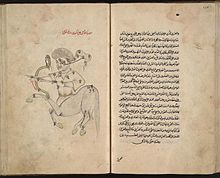
The constellation Sagittarius from The Depiction of Celestial Constellations
He identified the Large Magellanic Cloud, which is visible from Yemen, though not from Isfahan; it was not seen by Europeans until Magellan’s voyage in the 16th century.[5][6] He also made the earliest recorded observation of the Andromeda Galaxy in 964 AD; describing it as a “small cloud”.[7] These were the first galaxies other than the Milky Wayto be observed from Earth.
He observed that the ecliptic plane is inclined with respect to the celestial equator and more accurately calculated the length of the tropical year. He observed and described the stars, their positions, their magnitudes and their colour, setting out his results constellation by constellation. For each constellation, he provided two drawings, one from the outside of a celestial globe, and the other from the inside (as seen from the Earth).
Al-Sufi also wrote about the astrolabe, finding numerous additional uses for it: he described over 1000 different uses, in areas as diverse as astronomy, astrology, horoscopes, navigation, surveying, timekeeping, Qibla, Salat prayer, etc.[8]
Since 2006, Astronomy Society of Iran – Amateur Committee (ASIAC) hold an international Sufi Observing Competitionin the memory of Al-Sufi. The first competition was held in 2006 in the north of Semnan Province[9] and the second was held in the summer of 2008 in Ladiz near the Zahedan. More than 100 attendees from Iran and Iraq participated in the event.[10]
Gallery
-

Constellation Taurus
-
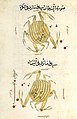
Constellation Cancer
-

Constellation Lepus
-
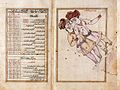
Constellation Gemini
-

Constellation Andromeda
-

Constellation Ophiuchus

Because of the prominent role of Muslim astronomers during the Islamic Golden Ages, many of the stars that have been named, actually have an Arabic name. The names are Latinized, but we can often find traces of the Arabic words in them.
Islamic astronomers, such as Abd al-Rahman al-Sufi, had an important role in the process of our knowledge of astronomy. They translated important information, such as the famous work of Ptolemy, Almagest. This work included an outline of Aristotle’s cosmology, the motions of the stars, the moon, Jupiter and Saturn, the eclipses and so on.
To be able to translate a work as complex as this, one had to have enough knowledge and understanding of the matter himself. The Arabic astronomers not only translated the works, but also added a lot of important information themselves.
Many of the names of these stars were eventually copied and used in Europe, in a lot of times not knowing that the origin of these names is Arabic.
Below you will find a few examples of bright stars with a, although Latizined, Arabic name.
Altair – النّسر الطّائر
The name of this star is actually a shortened version of ‘an-Nisr uṭ-Ṭā’ir’, meaning the flying Eagle.

Rigil Kentaurus – رجل القنطورس
Rigil Kentaurus, derives from ‘Rijl ul-Qanṭūris. Translated, this would be Foot of the Centaur.

Betelgeuse – إبط الجوزاء
Betelgeuse, meaning armpit of the central one, comes from the Arabic name ‘Ibṭ ul-Jawzā’.

Deneb – ذنب الدجاجة
Deneb is a shortened version of ‘Dhanab ud-Dajājah‘, meaning tail of the hen.

Alnitak – النطاق
Having the meaning of the girdle, this star is named Alnitak, originating from the Arabic word ‘an-Niṭāq’.

Fomalhaut – فم الحوت
This star was given the name ‘Fum al-Hul’ in Arabic, meaning mouth of the Whale. It is known as the star Fomalhaut.

Algol – رأس الغول
Algol is the shortened version of the Arabic name ‘Ra’as al-Ghūl’. We recognize the word ghoul in it. A ghoul is a figure in Arabic legends and is a kind of demon, scary monster.

The list goes on and on and on! So many bright stars have a name that originates from Arabic. Unfortunately, there is no room for all the stars in one article. But the list of Arabic named Stars are only one Google click away! And don’t forget to watch the starry sky more often!
 Aal-e-Qutub Aal-e-Syed Abdullah Shah Ghazi