


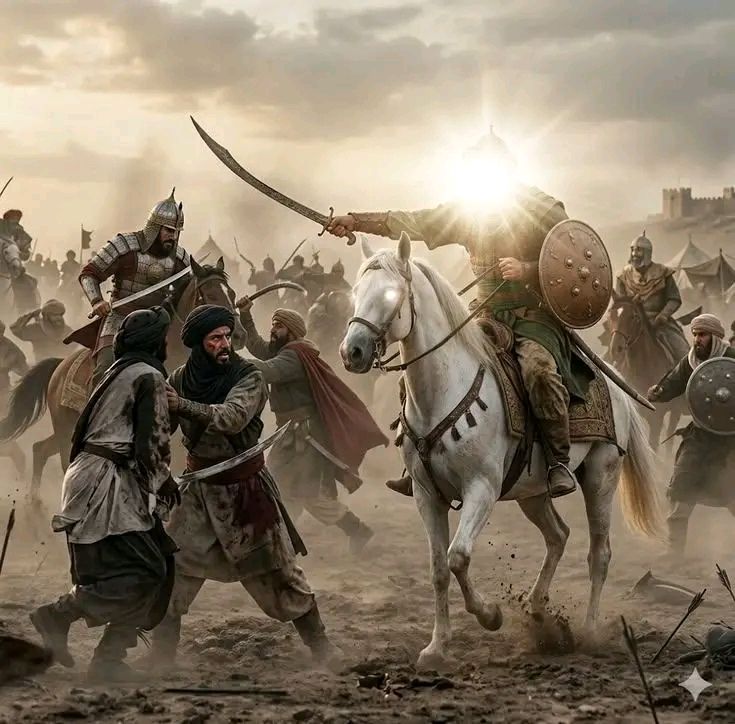
■ Imām al‑Shādhilī, may Allāh sanctify his noble secret, and the Spiritual Valor at the Battle of al‑Mansurah.
Throughout Islamic history, the convergence of spiritual fortitude and worldly courage has produced figures whose influence transcends both domains.
One of the most remarkable examples of this phenomenon is Imam Abū al‑Ḥasan ‘Alī ibn ‘Abd Allāh al‑Shādhilī, the founder of the Shādhilī Sufi order, whose life and teachings left an indelible mark on the Muslim world.
Although Imām al‑Shādhilī is primarily remembered as a spiritual guide, his presence during the Battle of al‑Mansurah in 1250 CE, when French Crusaders under King Louis IX invaded Egypt, demonstrates how spiritual authority can play a decisive role even in the theatre of war.
The Seventh Crusade was launched by the French monarch Louis IX with ambitions of conquering Egypt, controlling the Nile valley, and establishing European dominance in the region.
Egyptian defenses, however, were both strategically and morally fortified. Commanders such as Fakhr al‑Dīn and the future Mamluk sultan Baybars orchestrated a careful defensive strategy centered on al‑Mansurah, turning the city into a trap for the invading forces.
The Crusader army, despite its numerical strength and technological advantage, faced overwhelming resistance and strategic ingenuity from the local defenders.
The resulting battle ended in a catastrophic defeat for the French forces, culminating in
the capture of King Louis IX, and marking a decisive moment in the history of Egypt’s defense against foreign invaders.
Amid the turmoil of battle, Imam al‑Shādhilī’s involvement is remembered not in the form of wielding weapons, but through the power of spiritual presence.
By the time of the Crusader invasion, he was nearly blind, a condition said to have arisen from illness and years of intense spiritual practice. Despite this frailty, Imām al‑Shādhilī is described in Sufi tradition as standing with his disciples, reciting the Hizb al‑Nasr a litany invoking divine assistance and victory.
The recitation of these sacred words, though intangible, was believed to strengthen the resolve of the Egyptian defenders and infuse them with courage.
His presence symbolized the idea that true leadership and heroism do not always require physical prowess; the influence of the soul, the strength of devotion, and the power of prayer can inspire action that alters the course of events.
The story of Imām al‑Shādhilī at al‑Mansurah represents a rich intersection of history and spiritual narrative.
Historical accounts, such as the chronicles
of Ibn Wāṣil and Abū Shāma, document the decisive defeat of the Crusaders and the strategic brilliance of the Egyptian commanders.
Sufi traditions, however, layer this history with profound symbolism, portraying the near-blind Imam as a figure whose spiritual guidance was a weapon more potent than the sword.
This duality between historical fact and spiritual interpretation reflects a recurring theme in Islamic thought: victory is not solely determined by material means, but by the alignment of the human heart with divine will.
The blindness of Imām al‑Shādhilī carries additional symbolic weight. In Sufi teachings, physical sight is often contrasted with spiritual insight.
That Imām al‑Shādhilī could be nearly blind yet profoundly effective in guiding and inspiring others underscores a central Sufi principle: the soul’s vision transcends the limitations of the body.
His condition is remembered not as a weakness but as a testament to the depth of his spiritual perception.
Even in apparent vulnerability, the Imām’s presence radiated authority and courage, reminding all who witnessed or learned of the event that true strength is measured in faith and devotion rather than in mere physical capability.
Furthermore, the narrative of Imām al‑Shādhilī exemplifies the broader Sufi understanding of spiritual heroism.
The battle of al‑Mansurah, while a historical military engagement, becomes in the Sufi imagination a stage for moral and spiritual demonstration.
The courage of the defenders, the strategic genius of the commanders, and the spiritual influence of Imām al‑Shādhilī together portray a multifaceted conception of victory.
It is achieved not only through force, but through the inspiration of hearts, the alignment of purpose with divine will, and the courage to act righteously in the face of overwhelming odds.
This story has endured in Muslim memory precisely because it conveys multiple layers of meaning. On one level, it recounts a critical historical moment in the defense of Egypt against foreign invaders.
On another, it elevates the figure of Imām al‑Shādhilī as a paradigm of spiritual resilience, illustrating that even those deprived of physical faculties can influence events profoundly through faith, prayer, and moral example.
The near-blind Imam’s presence in the midst of danger reflects a timeless lesson: leadership, courage, and heroism are as much about the guidance of the soul as the action of the body.
In conclusion, the account of Imām al‑Shādhilī at the Battle of al‑Mansurah transcends mere historical narrative.
It presents a vision of heroism that intertwines the material and spiritual worlds, highlighting how devotion and moral authority can shape outcomes even in the chaos of war.
His near-blindness serves not as a limitation but as a symbol of spiritual insight, and his recitation of sacred litanies reminds generations that the heart, when aligned with divine purpose, can wield power far beyond the reach of physical force.
Imăm al‑Shādhilī’s story continues to inspire, offering a profound model of courage, guidance, and the enduring potency of spiritual presence in the most testing circumstances.

 Aal-e-Qutub Aal-e-Syed Abdullah Shah Ghazi