

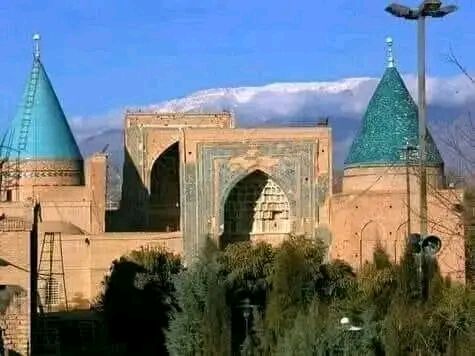
Hazrat Bayazid Bastami (رحمة الله عليه) belonged to the city of Bastam in Iran. He was among the greatest saints of his era. Allah Almighty had bestowed upon him such rare spiritual qualities that very few were granted the like. His rank can be understood from the fact that even a great master like Hazrat Junayd Baghdadi (رحمة الله عليه) would constantly praise him.
It is said about him that the height of Tawḥīd (Divine Oneness) was his very beginning, for even at the first step people would become amazed and bewildered.
Hazrat Bayazid Bastami (رحمة الله عليه) narrates a remarkable event from his life:
“Once, during a journey, I was enjoying solitude, deeply immersed in reflection and finding intimacy in the remembrance of Allah. Suddenly, a voice called within my heart:
‘O Bayazid, go to the Monastery of Sim‘ān and attend the Christians in their festival and sacrifice. A magnificent event will occur there.’
I recited A‘ūdhu billāh and said that I would not allow such a thought to return.
But when night came, I heard the same voice in a dream. When I awoke, my body was trembling. I began to wonder whether I should obey this command or not. Then a voice from within said:
‘Do not be afraid. You are among Our chosen friends and are written in the register of the righteous. Wear the clothes of the monks and tie the Christian belt (zunnār) for Our pleasure. There will be no sin upon you.’”
Hazrat Bayazid says:
“Early in the morning, I put on the clothing of the monks, tied the belt, and went to the Monastery of Sim‘ān. It was their festival day. Monks from different regions had gathered to receive blessings and listen to the teachings of their chief priest. I also sat among them in the disguise of a monk.”
When the chief priest climbed the pulpit, everyone fell silent. But as soon as he intended to speak, the pulpit began to tremble, and he was unable to utter a word, as if his mouth had been restrained.
The monks and scholars asked, “O spiritual guide, what is preventing you from speaking? We seek guidance from your words.”
The priest replied, “There is a Muhammadan (a follower of Muhammad ﷺ) sitting among you. He has come to test your religion.”
The people said, “Show him to us, and we will kill him at once.”
The priest said, “Do not kill him without proof. I will test him with questions about the knowledge of religions. If he answers correctly, we will leave him. Otherwise, we will kill him.”
Then he called out:
“O Muhammadan, I swear by Muhammad—stand up so that everyone may see you.”
Hazrat Bayazid (رحمة الله عليه) stood up, while words of glorification and praise of Allah flowed from his tongue.
The priest said, “I will ask you several questions. If you answer them correctly, we will follow you. Otherwise, we will kill you.”
Hazrat Bayazid replied:
“Ask whatever you wish—whether by reason or by revelation. Allah is Witness between you and me.”
Then the priest asked many questions, including:
What is the One that has no second?
What are the two that have no third?
The three that have no fourth?
The four that have no fifth?
The five that have no sixth?
The six that have no seventh?
The seven that have no eighth?
The nine that have no tenth?
The ten that have no eleventh?
The twelve that have no thirteenth?
Who are the people who lied yet entered Paradise?
Who are the people who spoke the truth yet will enter Hell?
Where in your body does your “name” reside?
What are Adh-Dhāriyāt, Al-Ḥāmilāt, Al-Jāriyāt, and Al-Muqassimāt?
What is that which is lifeless yet breathes?
Who are the fourteen that spoke with the Lord of the worlds?
What is the grave that carried its occupant?
What is the water that neither came from the sky nor from the earth?
What are the four that were not born from a father’s back nor a mother’s womb?
What was the first blood shed on earth?
What did Allah create and then “buy”?
What did Allah create and then dislike?
What did Allah create and then praise?
What did Allah create and then ask, “What is this?”
Which women are the best among all women?
Which rivers, mountains, animals, months, and nights are the best?
What is Ṭāmmah?
What is the tree with twelve branches, thirty leaves on each branch, and five flowers on each leaf?
What is that which performed Hajj and circumambulated the Ka‘bah, though it has no life and Hajj is not obligatory upon it?
How many prophets were there, how many messengers, and how many non-messengers?
What are the four things that have different tastes and colors but the same root?
What are Naqīr, Qiṭmīr, Fatīl, Sabd wa Labd, and Ṭamm wa Ramm?
What do animals say when they make their sounds?
Which nation received revelation though they are neither human, jinn, nor angels?
Where does the day go when night comes, and where does the night go when day comes?
Hazrat Bayazid (رحمة الله عليه) answered every question clearly and with references from the Qur’an and Divine wisdom, explaining:
The One with no second is Allah.
The two are day and night.
The three are the Throne, the Chair (Kursi), and the Pen.
The four are the four revealed books: Torah, Gospel, Psalms, and Qur’an.
The five are the five daily prayers.
The six are the six days of creation.
The seven are the seven heavens.
The eight are the angels who carry the Throne.
The nine were the nine corrupters among the people of Pharaoh.
The ten are the ten days of fasting for one who cannot offer sacrifice.
The eleven were the brothers of Prophet Yusuf (Joseph).
The twelve are the months of the year.
The fourteen were the seven heavens and seven earths.
The “grave that carried its occupant” was the fish that swallowed Prophet Yunus (Jonah).
The lifeless thing that breathes is the morning.
The water not from sky or earth was the sweat of the horses sent by Queen Bilqis.
The four not born from father or mother are Adam, Hawwa (Eve), the ram of sacrifice, and the she-camel of Salih.
The first blood shed was Habil (Abel), killed by Qabil (Cain).
What Allah created and “bought” is the soul of the believer.
What Allah created and disliked is the braying of a donkey.
What Allah created and asked about was the staff of Musa (Moses).
The best women are Hawwa, Khadijah, Aishah, Asiyah, and Maryam.
The best rivers are Sayhun, Jayhun, Tigris, Euphrates, and the Nile.
The best mountain is Mount Sinai (Tur).
The best animal is the horse.
The best month is Ramadan.
The best night is Laylat al-Qadr.
Ṭāmmah is the Day of Judgment.
The “tree” is the year: its branches are months, leaves are days, and flowers are the five daily prayers.
The thing that made Hajj was the Ark of Prophet Nuh (Noah).
The number of prophets is 124,000, and messengers are 313.
The four things with one root are eyes, nose, mouth, and ears, whose root is the brain.
He explained even the meanings of the sounds of animals and the symbolic terms mentioned.
Finally, Hazrat Bayazid said:
“If I have answered all your questions, will you believe in Allah and His Messenger Muhammad ﷺ?”
They all agreed.
Then Hazrat Bayazid asked the priest:
“What is the key to the heavens and the key to Paradise?”
The priest lowered his head and said:
“The key to the heavens and Paradise is:
Lā ilāha illā Allāh, Muhammadur Rasūlullāh.”
At that moment, all the monks recited the Shahadah and accepted Islam, breaking their belts (zunnār) on the spot.
A voice from the unseen called out:
“O Bayazid, We commanded you to wear one belt so that five hundred belts might be broken.”

 Aal-e-Qutub Aal-e-Syed Abdullah Shah Ghazi