

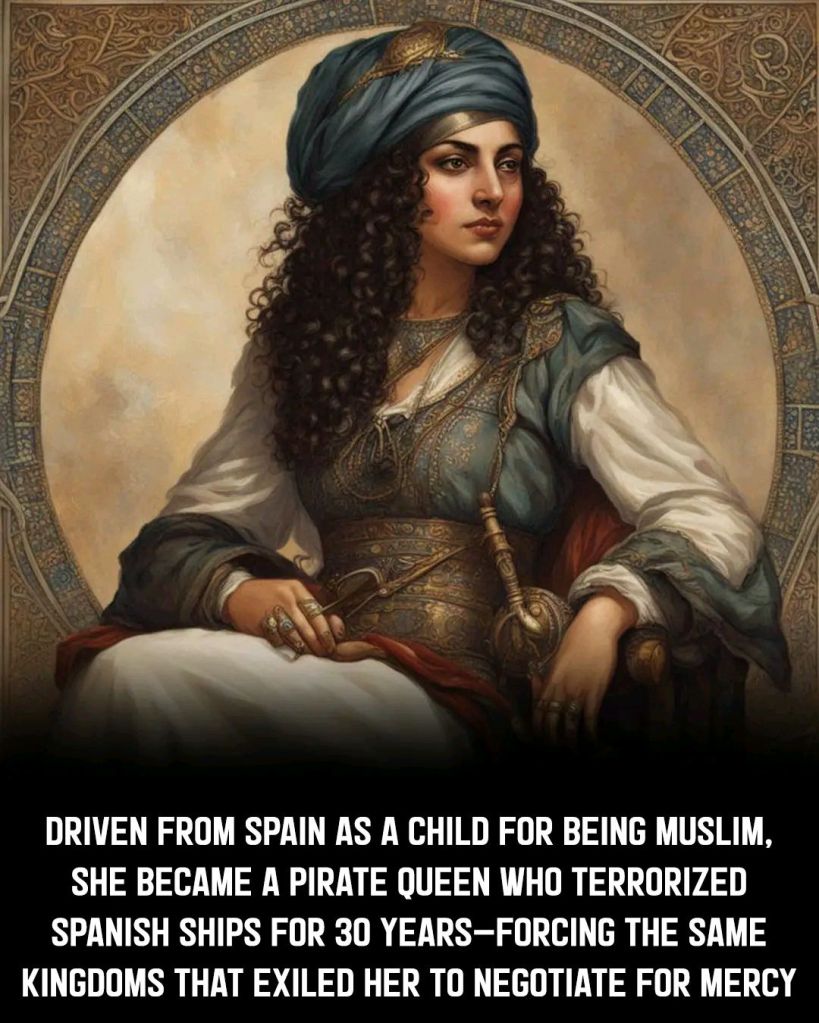
She was forced into exile as a child. So she became a pirate queen who terrorized the Spanish fleet for 30 years.
This is 1492. The same year Columbus sails for the Americas, something else is happening in Spain that will change the Mediterranean forever.
Granada falls. The last Muslim kingdom in Spain surrenders to Catholic monarchs Ferdinand and Isabella. And the Spanish Crown issues an ultimatum to every Muslim and Jew in Spain: convert to Christianity, or leave.
Among the families fleeing is a young girl named Lalla Aicha. Her family had wealth, status, education—everything except safety. They pack what they can carry and join the desperate exodus across the sea to Morocco, leaving behind the only home they’ve ever known.
Lalla Aicha is just a child. She doesn’t understand why her family’s world is collapsing. She only knows that Spanish soldiers and Christian mobs have made it clear: Muslims are no longer welcome in the land their families have lived in for 800 years.
The family settles in Chefchaouen, a mountain refuge in northern Morocco filled with other Spanish exiles. Despite losing everything, Lalla Aicha’s family manages to rebuild some of their former status. And they do something remarkable: they educate their daughter.
Not just basic literacy—Lalla Aicha receives an education that rivals what most men receive. She studies languages, mathematics, theology, history. She learns to read and write in Arabic and Spanish. She’s trained in diplomacy, governance, and strategy.
Her family is preparing her for something, though perhaps even they don’t know what yet.
In the early 1500s, Lalla Aicha marries Abu Hassan al-Mandri, the governor of Tétouan—or what’s left of it. Tétouan is barely a city anymore, just ruins left from previous wars. The Sultan grants them permission to rebuild it, to create a new home for the Spanish Muslim refugees still arriving.
Together, they transform Tétouan from rubble into a thriving city. They build walls, mosques, markets, homes. They create a refuge for the exiled, a place where Spanish Muslims can rebuild their lives.
And then, around 1515, Abu Hassan dies.
By all expectations of 16th-century Islamic society, Lalla Aicha should have quietly retired. She should have let male relatives take over governance. She should have disappeared into the background of history.
Instead, she takes power.
She assumes the title “Sayyida al-Hurra”—which means “the free and independent lady” or “the sovereign lady who bows to no one.” She becomes the governor of Tétouan, ruling in her own right, not as a regent for a son or a placeholder for male authority.
She is one of the very few Muslim women in history to rule independently with that title.
And then Sayyida al-Hurra does something that will make her name feared across Europe for three decades:
She becomes a pirate.
But she doesn’t do it alone. She forms an alliance with the most notorious corsair in the Mediterranean: Oruç Reis, known to Europeans as Barbarossa—”Redbeard”—the terror of the Barbary Coast.
They divide the Mediterranean between them. Barbarossa commands the eastern waters from his base in Algiers. Sayyida al-Hurra commands the western waters from Tétouan.
Together, they create a pirate empire that brings European maritime trade to its knees.
Here’s what makes Sayyida al-Hurra different from typical pirates: this isn’t just about money. This is about revenge.
She hasn’t forgotten being driven from her home as a child. She hasn’t forgotten watching her family lose everything because Spanish Christians decided Muslims no longer belonged in Spain. She hasn’t forgotten the friends and relatives who didn’t make it across the sea, who converted under duress or died trying to escape.
Every Spanish ship she captures is payback. Every Portuguese vessel she raids is justice. Every Christian merchant she holds for ransom is a reversal of power—now the Spanish have to beg her for mercy, have to negotiate with a Muslim woman, have to acknowledge her authority.
Her fleet terrorizes the Iberian coast. Spanish and Portuguese ships carrying goods from the Americas, from Africa, from the East—all are fair game. She captures vessels, seizes cargo, and takes prisoners. The ransoms from wealthy Christian captives make her enormously wealthy.
But more than that, they make her powerful.
European kingdoms that ignored Muslim refugees fleeing Spain suddenly have to negotiate with a Muslim woman pirate queen. They send ambassadors to Tétouan. They write letters addressing her formally, respectfully, because she holds their citizens and they need her cooperation to get them back.
Sayyida al-Hurra becomes the primary point of contact for European-North African prisoner exchanges. The same European powers that drove her from Spain now have to treat her as a legitimate ruler.
The irony is not lost on her.
For over 30 years, she rules Tétouan and commands the western Mediterranean. She’s so powerful that when the King of Morocco proposes marriage, he doesn’t demand she come to him—he travels to Tétouan for the wedding, the only time a Moroccan sultan marries outside the capital.
Even in marriage, Sayyida al-Hurra refuses to give up her independence or her power.
But power always attracts betrayal.
Around 1542, she’s deposed—the exact circumstances are unclear, lost to history. Some sources suggest her stepson removed her from power. Others hint at political intrigue within the Moroccan court. What’s certain is that after three decades of rule, her reign ends not by Spanish conquest but by treachery from within.
Sayyida al-Hurra returns to Chefchaouen, the mountain city where her family first found refuge decades earlier. She lives out her remaining years there, away from the sea she once commanded, away from the power she once wielded.
The date of her death is unknown. Her grave’s location is lost. The woman who was feared across the Mediterranean for 30 years vanishes into historical obscurity.
But her legacy remains.
Tétouan, the city she rebuilt, still stands—a UNESCO World Heritage Site preserving the Andalusian architecture and culture of Spanish Muslim exiles. The fortress walls she strengthened still protect the medina.
And her story survives as proof that women in Islamic history weren’t always confined to harems and domesticity. They could be governors, military commanders, pirate queens who negotiated with European powers as equals.
Sayyida al-Hurra never forgot being driven from her home. She spent 30 years making Spain pay for that exile. She transformed from refugee child to ruler to pirate queen, commanding fleets, amassing wealth, and forcing European kingdoms to acknowledge her power.
She was intelligent, educated, strategic, and absolutely ruthless when necessary. She built a city, ruled a territory, commanded the seas, and negotiated with kings—all while being a Muslim woman in the 16th century.
She was exiled from Spain as a child. So she became a pirate queen and terrorized Spanish ships for 30 years.
Sometimes revenge is a dish best served from the deck of a pirate fleet.

 Aal-e-Qutub Aal-e-Syed Abdullah Shah Ghazi