
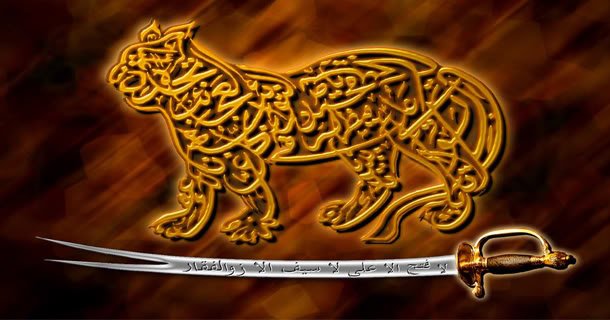

When the Holy prophet (A.S.) left his house at Mecca in the night and Ali was found in his bed, the Quraish at first thought of killing him, but when they found him ready to defend himself they gave up idea and dispersed in search of the Holy prophet (A.S.)
Ali as per orders of the Holy prophet (A.S.) stayed three days at Mecca and handed back all the articles which were entrusted to the Holy prophet (A.S.) for sale custody, mostly by his enemies, secured their receipts and left the city in broad daylight.
He was entrusted by the Holy prophet (A.S.) for safe transport of Holy prophet’s daughter Hazrath Fatima, daughter of Hamza, another Fatima, his own mother, a third Fatima, and his aunt, that was the daughter of Abdul Muttalib, a fourth Fatima. The Quraish wanted to prevent the departure of these four ladies. Eight prominent people came out to fight. Ali fought single handed with them. He killed Junah with a stroke of his sword and scattered the rest and continued the journey. On account of scarcity of mounts he had to travel on foot and thus he reached Madina with bleeding feet. Awaiting the arrival of Hazrath Ali the Holy prophet (A.S.) was staying at Qubba, two miles away from Madina, when he reached Qubba, on the 12th of Rabiul Awwal (probably the end of June) the Holy prophet (A.S.) embraced him, dressed his bleeding feet and ente red Madina along with him.
Before his migration to Madina the Holy prophet (A.S.) had created a bond of brotherhood between the Muslims. He had fraternized Hazrath Abobaker to Hazrath Omer, Hazrath Oosman to Abdul Rehman Ibne Oaf, Hazrath Hamza to Zaid Ibne Ha- resa and Talha to Zaubair. On that occasion he had fraternized Hazrath Ali to himself, saying, “Oh Ali, you are my brother in this world as well as in the next,” (Tharikh-e- Khamees Vol. I page 398).
1st A.H.
rive months after his arrival at Madina he fraternized the Mohajirs (the Migrators) with the Ansars (the citizens of Madina). On that occasion again he called Ali and said “Oh Ali you are my brother in this world and hereafter”. The historian Ibne Hashsham says “The Holy prophet (A.S.) caught the hand of Hazrath Ali and said ‘he alone is my brother’ thus the apostle of God, who was actually the leader of all the prophets as well
as of all the pious men of the world and who had no parallel among human beings by fraternizing with Hazrath Ali, showed that Ali also had no parallel among mankind except the Holy prophet (A.S.)” (Seerath-e-Ibne Hashsham Vol. II. Abul Fida Vol. I page 127, Musthadrik of Imam Hakim Vol. III and Fatchul Bari, commentary of Sahee Bokhari Vol. VII page 211).
2nd A.H.
During the 2nd year of Hijrath Hazrath Ali’s marriage took place with the Holy prophet’s daughter Fatima. Holy prophet (A.S.) was receiving many offers for his daughter from very rich people of Madina, from some of the Mohajirs and from chiefs of mighty clans of Arabia. He had refused even to consider these offers and sometime felt annoyed at them and at the end he closed the door by saying that he was awaiting the orders of God. The book Asadul Ghaba Fee Tameez-e-Sahaba, gives a detailed account of these offers and the way of refusal by the Holy prophet (A.S.). Some of the Ansars suggested to Hazrath Ali to place a proposal for himself before the Holy prophet (A.S.). Hazrath Ali went before him feeling shy and modest. This was the first time in his life that he talked reservedly to a man who was like a father unto him and to whom he was like a dear son. When the Holy prophet (A.S.) heard the proposal he was so pleased that he smiled and said. (It is a welcome and happy proposal) Tareekh-e- Khamees Vol. 1 page 407, 1bne Saad Vol. VIII pages 11 and 12, and Asadul Ghaba).
The Holy prophet (A.S.) took the consent of Hazrath Fatima for this proposal. The marriage ceremony was very simple and without pomp and ostentation. There was a Khutba from the Holy prophet (A.S.) in which he praised God mentioning some of His attributes and citing verses of the Quran and concluding with the remarks that he was ordered by God to give Harath Fatima into marriage with Hazrath Ali. This was follo wed by a Khutba from Hazrath Ali, praising God and the Holy prophet (A.S.) and desiring the gathering to witness his marriage with Hazrath Fatima the daughter of Holy prophet (A.S.). After this happy ceremony somebody reminded the Holy prophet A.S.) of his late companion in life the mother of Hazrath Fatima, Hazrath Khadija, and he said “Khadija: where is Khadija, who can be like Khadija, she testified me when the world was falsely accusing me as a liar, she relieved me of much of my weight, she was my partner in my work a. d she helped me when others were creating obstruction in my mission”.
After reaching Madina the Holy prophet (A.S.) stayed in the house of Kulsoom Ibne Hadam for seven months and Hazrath Ali was staying with him. When the Holy prophet (A.S.) finished the construction of mosque he built houses for his wives around it and in the centre of them he built a house for Hazrath Ali (Sahee Bokhari, para 14 page 387). Following his example many of his companions except Hazrath Aboobaker built their houses around the mosque. Hazrath Aboobaker was staying in the locality of Banee. Abde-Oaf where the marriages of both of his daughters took place and later on he shifted to Sukh (Bokhari Vol. 1). The doors of all the houses built around the mosque opened in the mosque. One day the Holy prophet (A.S.) ordered that except the doors of his houses and that of Ali all the other doors should be closed. Some of the companions requested him to allow them to keep a small window open. He replied “No, not a pin hole, God so willed it” (Musnad-e-Imam Ahmed, Musthadrik-e-Imam Hakim, Khasais-e-Nasaace)
In the year 2 A.H. battle of Bader took place (Keter Section 15 page 22)
3rd A.H.
In the year 3 A.H. the first child to Hazrath Ali and Hazrath Fatima was born and he was named Hassan (Imam Hassan) by the Holy prophet (A.S.).
In the same year (3 A.H.) battle of Ohad took place (refer Section 15 page 22) which was followed by despatch od expeditionary force to Hamaraul Asad under Haz- rath Ali.
4th A.H.
In the year 4 A.H., Hazrath Ali and Hazrath Fatima had the second child Hussain (Imam Hussain) who was also named by the Holy prophet (A.S.). In the same year a battle took place with Bani Nazeer and Hazrath Ali brought it to a successful end and Bani Nazeer were forced to vacate their fortress.
5th A.H.
In the year 5 A.H. three battles took place, battle with Banee Mustalaque, battle of Khundaque (the moat) and battle with Banee Kanza. In all three of them Ali was the commander of the army. Most important of them was the battle of Khundaque which I have narated in section 15 page 23).
6th A.H.
In the year 6 A.H. an expedition to Fadak was sent under the command of Hazrath Ali and without a battle or skirmish he brought the whole province under control of the Holy prophet (A.S.).
In Ziquad of this year the Holy prophet (A.S.) along with fourteen hundred Mu- slims left for Mecca with the intention of pilgrimage. He had no desire to fight anybody and had left all the armaments at Madina. When Quraish came to know about this intending pilgrimage they refused to allow the Holy prophet (A.S.) to enter Mecca. Khalid Ibne Waleed came out with a force of well equipped two hundred cavalry men to ob struct the Holy prophet (A.S.) and if necessary to fight over the issue. At an oasis called Hudaibia the oponents faced each other. A chieftain named Orwa from Quraish came out to discuss the situation with the Holy prophet (A.S.) and instead of a battle a treaty was arranged, and it was written by Hazrath Ali. The last clause of the treaty was that the present intention of the pilgrimage should be given up but next year the Holy prophet (A.S.) and Muslims can come for ‘Umra’.
7th A.H.
In the year 7 A.H. two battles ‘ook place, the Khyber and the Wadiul Quara. The more important of them was Khyber which I have accounted in section 15 page 25.
In the same year the Holy prophet (A.S.) along with Muslims went to perform Umra, it was very peaceful mission. The Holy prophet (A.S.) and many of the Muslims had their wives and children with them. The Umra was performed without any unpleasant incident taking place.








 Aal-e-Qutub Aal-e-Syed Abdullah Shah Ghazi