
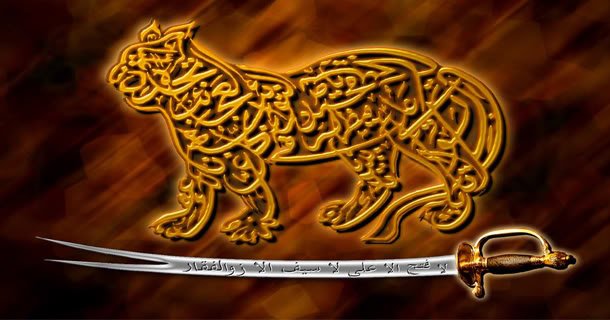


13. Ali’s Food
Hazrath Ali (A.S.) always ate such kind of rood and dressed in such a way that even the poorest can affort better than that. It was not because he was poor but it was because he wanted to lead the life of the poorest person and spend all that could thus be spared on poor. I have noted below certain cases quoted by the historians, these incidents are of the time when he was the ruler and king of the entire Muslim Empire except Syri-
(i) Imam Ahmed Ibne Humbal in his ‘Masnad’ cited Sowaeda-Ibne-Ghafla saying “One day I went to see Ali (A.S.) in the Government House (Darul Imarah). It was the time of breakfast and before him there was a cup of milk and some barley bread. The bread was dry, stale, hard and did not contain any butter, or oil. It could not be easily broken into pieces. Hazrath was exerting himself to break it and to soften it. I turned towards his slave, Fizza and said ‘Fizza! have you no pity upon your old master and why cannot you give him softer bread and add some butter or oil to it’? She replied why should I pity him when he never pities himself. He has given strict orders that nothing is to be added to his bread and even chaff and husks are not to be separated from the flour. We, ourselves, eat much better food than this, though we are his slaves’. Hearing this I told him O Lord, have pity on yourself, look at your age, your responsibilities,your hard work and your food. He replied ‘O Sowaeda, you have no idea what the Holy prophet (A.S.) used to eat. He never ate full stomach for three consecutive days.”
(ii) Allama Kamal-ud-din Mohammed-Ibne-Talha-e-Shafeyee in his book Matalib-ul-Soul quotes Abdullah Ibne Zurare saying “I went to see Hazrath Ali (A.S.) on an Eid day. He asked me to join in his breakfast. I agreed. A very poor kind of food was served before us. I told him, O Lord, you are such a rich man, a caliph and a king. I was expecting that game would be served before us but what do I see? Hazrath replied ‘Ibne-Zurare, you have heard of mighty kings who have lead life of luxury. Let me be a ruler leading the life of a poor and humble person-a humble labourer’.
(iii) Millance in his book “Seerath” and Iman Ahmed in his Musnad quote the famous ‘Tabayee’ Ibne Abee-Rafay, who says that he went to Hazrath on an Eid day and while he was sitting there a bag was brought before Hazrath, he thought that it might contain jewels, Hazrath opened the bag, it contained dried pieces of bread, which he softened with water. Ibne Abee Rafay asked him as to the reason of sealing such a king of food which even a beggar would not care to steal. Hazrath smiled and said “I keep it sealed because my children try to substitute softer bread, containing oil or butter in it”. Ibne Abee Rafay said, “Has God prohibited you to eat better kind of food? He replied “No, but I want to eat the kind of food which the poorest of this realm can afford at least once a day. I shall improve it after I have improved their standards of life. I want to live, feel and suffer like them”.
14. His Dress
(i) Iman Ahmed in his book “Almunaaquib” and Ibne Aseer in his history quote Haroon Ibne Anzaa saying that he accompanied his father (Anzaa) to the “Khorenique” castle to meet Hazrath Ali, those were winter days, and the winter was very severe, he found Hazrath in a very thin cotton garment, and the cold wind was making him shiver. Anzaa asked him “O Commander of faithful! God has reserved a share for you and your family from Baithul Mal (Muslim Treasury) why do you not make use of it”. He replied “O Anzaa! I do not want anything from your treasury, this is the dress I have brought with me from Madina”.
(ii) Imam Ahmed quotes Zaid Ibne Wahab saying that once Hazrath came out of his house and there were patches sewn to his dress. Ibne Noaja, who was a Kharijite and an enemy and yet was allowed to lead a peaceful and comfortable life by Hazrath at Koofa taunted Hazrath on the very poor and coarse kind of dress put on by him. He replied “Let go, what have you to find objection in my dress, it is the kind which our masses can afford, why can you not think of their lives and dresses, I shall improve my standard after I have succeeded in improving theirs. I shall continue to live like them. Such kind of dress makes one feel humble and meek and give up vanity, haughtiness and arrogance.”
(iii) Ali-ul-Muthaquee in his books Kunz-ul-Ammaal and Tabaree in Reyaz-ul- Nazarah quote Omer Ibne Quais saying that once he asked Hazrath as to the reason of his having patches in his dress, he replied “O Omer, such type of dress makes you soft hearted, vanishes vanity from your mind and it is the kind which poor Muslims can conveniently afford.”
(iv) Shaik-ul-Islam Iman Abu Omer Eusuf Ibne Abdul Burr in his book Al Istheeaab quotes Hussan Ibne Jermoze saying that his father once saw Hazrath coming out of Koola mosque in a shirt made of jute cloth and around him were people so well dressed that compared to him they looked like princes, he was advising them as to how understand religion.
(♥) Imam Ahmed quotes Abu Nozia, the ready-made cloth merchant of Koofa saying that Hazrath purchased two shirts from his shop, one was of supperior quality, which he handed over to his slave Quamber to put on and the other which was of a rough cloth, very coarse and cheap, he reserved it for himself.
15. His services to Islam and the Holy Prophet (A.S.)
(i) The first occasion on which Ali offered his services to the cause of Islam was when the Holy Prophet (A.S.) was first ordered by God to preach Islam openly.
For three years the Holy prophet (A.S.) was preaching Islam under absolute secrecy, at the end of the third year (i.e. the fourth year after ‘Baysuth’, in 45 Aamul Feel) he received orders to preach his near relations and to admonish them. “The Holy Prophet (A.S.) directed Ali to prepare an entertainment and to invite the sons and grandsons of Abdul Muttalib. This was done and about forty of them came, but Abu Lahab, made the company break up before Mohammed (A.S.) had an opportunity to speak. Next day a second invitation was issued and when they came and the frugal meal was served the Holy prophet (A.S.) rose and declared his sacred character, offered the treasures of time and of eternity to whom-soever should become his disciples, and concluded by demanding, who among you will aid me to bear this burden, who will be my Lieute- nent, and Vazir, as Aron was unto Moses? The assembly remained mute with astoni shment, not one venturing to accept the offered perilous office, until Ali, Mohammed’s cousin, stood up and exlaimed ‘O prophet’! I will, though I am indeed the youngest of these present, the most rheum of them as to the eyes and the slenderest of them as to the legs; I, O prophet, will be thy Vazir over them’. On which throwing his arms around the generous and courageous youth, and pressing him to his bosom, Mohammed (A.S.) declared; “Behold my brother and my Vazir and obey him”. (John Devonport “An apology for Mohammed and Quran”).
Many historians are of opinion that it was a momentous declaration at a momentous occasion. The first and the greatest service done to the cause of Islam. If the appeal of the Holy prophet (A.S.) was then left unanswered the propagation of Islam would have been nibbed in the bud. Carlyle is of the opinion that though all the people gathered there, were not enemies of the Holy prophet (A.S.) ye most of them were dead against this religion and some were quite uninterested. To them the whol thing (and adult person preaching a new religion and a young courageous youth offering his services vehemently) looked like a big farce. They laughed at both of them and dispersed advising Ali’s father to obey his youngest son from that day onward. But these two people (Holy prophet, A.S., and Hazrath Ali) proved to the world that there was nothing laughable in their declaration and they had widsdom and courage enough to make their mission a success. He further says that young Ali had really such a personality as could be liked, loved and venerated by everybody. He was the man of excellent character lo ving and lovable, so intensely rave that if anything stood against his bravery it was
consumed as if by fire, yet he was so gentle and kind that he represented the model of a Christian Knight.
As was said this was really the first and the greatest service of Islam. From this day to the last day of his life. Hazrath Ali sincerely, bravely and nobly acted as the defender of the faith.
(ii) The second great occasion was when the Holy prophet (A.S.) was forced to leave Mecca, making somebody stay in his place in such a way that his enemies would believe that he was still in his house and thus he might safely go away in the darkness of the night. This departure to Madina is called Hijrath and the Muslim era is named after this event. It took place during the month of September, 662 A.D. Thursday the 26th Safar (thirteen years after the Holy prophet, A.S., started preaching Islam). People of Madina were favourably inclined towards Islam and some had embraced this religion and had promised every kind of support to the Holy Prophet (A.S.). Many Muslims had left for Madina and were handsomely treated by Ansars of Madina. Quraish realizing that Islam was gaining a good support and a firm hold at Madina and those who had fled from Mecca were being happily settled there, decided to strike at the root cause. Their hatred of the Holy prophet (A.S.) was so intense that nothing would satisfy them but his death. They gathered at Noodva and decided that a few people from each clan of Quraish would jointly attack the Holy prophet (A.S.) and strike him with their swords at one and the same time. Thus no individual of any single clan would be responsible of his death, and Bani Hashim would not be able to kill any one person in return or to fight against any single clan and as they were not strong enough to fight against all the clans of Quraish at the same time they woul be forced to be satisfied with blood-money (Diyat). They further decided to surround the house of the Holy prophet (A.S.) during the night so that he may not go away and then to kill him next morning. Thus forty men got ready and surrounded his house. God revealed to His apostle of the intrigue planned against him and oredered him to leave Mecca the very same night. It was a serious and dangerous occasion. He was ordered by God to go and to go in such a way that none of his enemies might suspect his departure and, if possible, none of his friends might know of it. The walls of his house were barely seven feet high and anyone placing a stone and standing upon it could easily peep into the house. He knew the house was surrounded. Whom could he ask to sleep in his bed covering himself with his (Holy prophet’s) coverlet, such a person should not expose his iderity till the dawn (till the prophet was safe and out of danger; and should be unarmed, so that he might not rouse the suspicion of peeping enemies; he should thus be willing to bear the brunt of the enemies’ anger in the morning and be ready to be killed. To whom but to Ali, could the Holy prophet (A.S.) turn at this most dangerous moment. In details he informed Ali of the whole plan and of the positive danger of taking his place saying that the least could be expected of those enemies would be death without torture. Ali asked “If I take your place and leave you alone to go through the gathered enemies will your life be safe?” “yes” replied the Holy prophet (A.S.). “God has promised me a safe passage through them”. Ali bowed his head before God as a sign of thanks-giving. He lied down on the bed of the Holy prophet (A.S.) and covered himself with the prohet’s coverlet. During the night many stones and arrows were aimed at him. Stones hit him in the back and on the head and arrows embedded in his legs but he did not even turn in his bed. In the morning he was found out by the enemies only when one of them pulled the coverlet. When they wanted to attack him knowing that he was Ali not Mohammed (A.S.), only then he unsheathed bis sword.
In Madina the Holy prophet (A.S.) was forced to defend himself and his followers, and was thus forced to fight many battles. At each and every battle Ali was the hero. And it was he who fought single-handed with famous worriors of Arabia, defeated the enemies and brought a victory to Islam.
Records of these battles carry with them chronicles of his bravery, courage and chivalry. Even the enemies sang songs of his valour and gallantry.
Every one of these battles was an outcome of very grave circumstances and conditions, and combination of very serious events and very harmful forces against the safety of the Muslims and Islam. There were many such encounters but I have briefly mentio ned only five of those instances where the events had far reaching effects. In each of them Ali alone broke through evil combinations and carried the Muslims and Islam to position of safety, eminence and power.
(iii) The first of these battles was Bader. It took place in the month of Ramazan of the 2nd year of Hijrath. Muslims were not prepared for a battle and could ill-afford to fight against superior forces. But Madina was being invaded and necessarily the Holy prophet (A.S.) was forced to defend himself and his followers. He decided to leave Ma- dina and fight out the battle in an open field. He had only 313 Muslims who were not adequately armed for a battle, many of them were nervous of an encounter, and were suffering from inferiority complex. The Quraish had come with an army of about 1000 warriors which fact had frightened the Muslims even more. The battle took place and about 36 Quraish were killed by Ali; some of them were very important persons and famous warriors of Quraish.
Ali killed every one of those 36 antogonists in hand to hand combat, and most of them were the persons who had surrounded the house of Holy prophet (A.S.) on the night of Hijrath. During this encounter he was wounded, but by his bravery and courage he brought home to Muslims that he would act as the first line of defence for Islam, that they had no cause to suffer from inferiority complex and that God would defend them against heavy odds. Amongst Quraish there were two worst enemies of Islam, Abu Jehal and Abu Sufyan; and in this battle Abu Jehal was killed. Ali was hero of this battle and brought the first victory to Islam in armed encounters with its enemies.
(iv) The second most important battle was that of Ohad. Quraish and their leader Abu Sufyan were smarting under the defeat of Bader and had sworn to retaliate. The idolaters were burning for revenge. They made formidable preparations for another encounter and succeeded in obtaining assistance of Thihama and Kinana tribes. Abu Su- fyan’s wife Kinda, mother of Moavia, took keen interest in all arrangements and preparations. She had written poems to excite Quraish against Islam and had organized a band of women ministrels who accompanied the army of Quraish to the battle field. Thus they had mobilised an army of 3000 infantry and 2000 cavalry. The Holy prophet (A.S.) could muster only 700 Muslims to face this horde. They faced each other in the battle-field of Ohad. The battle took place on the 11th Shawal 3 A.H. (a year after the battle of Bader). The command of Muslim army was divided between Ali and Hamza and Abu Sufyan had appointed Khalid Ibne Waleed, Akram Ibne Abu Jehal and Omer Ibne Aass as the three commanders to command the right and left wing and the centre
respectively.

 Aal-e-Qutub Aal-e-Syed Abdullah Shah Ghazi