

9. His Character:
1. Jurjy Zaidan (George Gordan) who died recently was a famous Christian histo rian, linguist, philosopher and poet of the modern Egypt. Arabic was his mother tongue, but he was so well versed in English, French, Germany, Persian and Latin that he used to contribute to historical and philosophical Magazines of France, Germany and England. About Hazrath Ali he says:
None can praise to the extent that he (Ali) deserves. So many instances of his piety and fear of God are cited that one starts loving and venerating him. He was a true, strict and scupolous follower of Islam. His words and deeds bore stamps of nobility, sagacity and courage of conviction. He was a great man having his own independent views about life and its problems. He never deceived, misled, or betrayed anybody. In various phases and periods of his life he exhibited marvelleous strenght of body and mind which were due to his true faith in religion and in his sincere belief in truth and justice. He never had servant and never allowed his slaves to work hard. Often he would carry his household goods himself and if anybody offered to relieve him of the weight he would refuse.
II. The famous Egyptian philosopher and Professor of Islamics of Alazhar University, Allama Mohammed Mustafa Beck Najeeb in his equally famous book “Hima’ethul Islam” says: “What can be said about this Imam? It is very difficult to fully explain his attributes and qualities. It is enough to realize that the Holy prophet (A.S.) had named him the gateway of knowledge and wisdom. He was the most learned person, the most brave man and the most eloquent speaker and orator. His piety, his love of God, his sincerity and fortitude in following religion were of such high order that none could aspire to reach him. He was the greatest politician because he hated diplo macy and loved truth and justice, his was the policy as taught by God. On account of his sagacity and through knowledge of human mind he always arrived at correct conclusion and never changed his opinions. His was the best judgment, and had he no fear of God he would have been the greatest diplomat amongst the Arabs. He is loved by all, and everyone has a place for him in his heart. He was a man of such surpassing and preeminent attributes and such transcending and peerless qualities tha: many learned men got perplexed about him and imagined him to be an incarnation of God. Several men amongst Jews and Christians love him and such philosophers who came to know of his Leachings bow down before his incomparable vast knowledge. Roman kings would have

his pictures in, their palaces and great warriors would engrave his name on their swords”. (Hima’athul Islam, part I, page 98)
III. Another philosopher and historian of Egypt Ustad (professor) Mohammed Kamil Hatha, pays his tributes in the following words: His life is a agglomeration of pleasing incidents, bloody encounters and sad episodes. His personality is very prominent on account of his transcending and high qualities. Each aspect of his life is so lofty and glorious that a study of one phase would make you feel that it was the best phase of his character and the most beautiful picture of his personality, while contemplation of any other phase will enchant you more and you will come to the conclusion that no human-being can attain that height, and a third aspect will fascinate you equally and you will realize that before you is a personality of such great eminence that you cannot fully appreciate its greatness and you will feel that Ali was an Imam (Leader) in battlefield, was an Imam (Leader) in polites, was an Imam (Leader) in religion, and also an Imam in ethics, in philosophy, in literature, in learning and wisdom. It is not difficult for God to create such a person (a review on the charater of Ali by Ustad (Professor) Mohanned Kamil Hatha Page 40)
IV. The historian John J. Pool (author of the life of H.M. Queen Victoria) in his book Studies in Mohammedanism says:
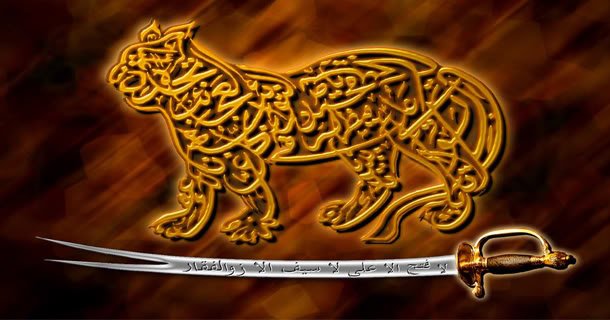
(i) This prince was a man of mild and forbearing character, wise in counsel and bold in war. Mohammed had given him the surname of “the Lion of God”.
(ii) Ali and his sons Hassan and Hussain were truly noblemen-men of righteousness man of a brave, a humble, and a forgiving spirit. Their lives deserve to be commemorated; for there was a peculiar pathos about them (their lives) which were not spent selfishly or in vain. As Mathew Arnold (Essays in Criticism) says “the sufferers of karbala had aloft to th eyes of millions the lesson so loved by te sufferer of Calvary (Representation of Crucification) :-“Learn of Me for I am meek and lowly in heart, and Ye shall find rest unto your souls”. He further says that Ali was the first Caliph to protect and encourage national literature. This prince was a scholar himself and many of his wise saying and proverbs are published in a book. It is a remarkable work and deserves to be more widely read in the West”.
V. Ibne-abil-Hadeed, the Mothazali commentator of Nahjul Balagha, says that: Hazrath Ali had a personality in when opposite characteristics had so gathered that it was difficult to believe a human mind could manifest such a combination. He was the bravest man that history could cite and such brave persons are always hard hearted, cruel, and cager for blood-shed. On the contrary Ali was kind, sympathetic, responsive and warm hearted person, qualities quite contradictory to the other phase of his character and more suited to pious and God fearing persons.
He was very pious and God fearing person and often pious and religious persons avoid society and do not care to mix with men of sins and men of wrath, similarly warriors, kings and dictators are usually arrogant and haughty, they consider it below themselves to mix with poor, lowly and humble persons. But Ali was different. He was friend to all. As a matter of fact he had a tendor spot in his heart for poor and humble,
and for orphans and cripples. To them he always was a kind friend, a sympathetic guide and a fellow sufferer; he was meek unto them but haughty and arrogant against famous warriors and generals, so many of whom he had killed in hand to hand combats. He was always kind but strict with wayward persons, sympathetically teaching then the ways fo God. He always smiled and passed happy and witty rejoinders, it was difficult to over. come him in debats or repartees, his rejoinders and retorts always bore high mark of culture, education and knowledge.
He was a scion of a very illustrious, rich and noble clan, as well as son-in-law and great favourite of the Holy prophet (A.S.), at the same time he was the greatest warrior and marshal of his time, yet inspite of his riches he ate, dressed and lived like a poor person to him wealth was for the use of other needy persons, not for himself and his family. Change of times and change of circumstances did not bring any change in his bearing, mien, or character. Even when he ascended the throne of Arabia and was acclaimed as the Caliph, he was the same Ali as they had found him to be during the previous regimes. Once in the society of Abdullah, son of Imam Malik-ibne-Humbel a discussion took place about Ali and his caliphate, Abdullah brought the discussion to an end saying that the caliphate did not bring any honour or glory to Ali, but it was itself honoured and glorified by Ali and it received the status actually due to it.
I want to add one more point to the points discussed by Ibne-abil-Hadeed. World cannot quote an example other than that of Ali a first class warrior and a marshal who is also a philosopher, a moralist and a great teacher of religious principles and theology. A study of his life shows that his sword was the only help that Islam received during its arly days of struggle and its wars of self-defence. For Islam he was the first line of de- ence, the second line of defence and the last line of defence. Who was with him in the battles of Bader, Ohad, Khundaque, Khyber and Hunain? This is one aspect of his life. While the other phase of his character is portrayed by his sermons, orders, letters and sayings. What high values of morality they teach, what ethics they preach, what intricate problems of unitarianism they elucidate, how rich they are in philosophy; how they try to train us to be kind, good, benevolent and God fearing rulers, and faithful, sincere and law abiding subjects; how they persuade us to be warriors who can fight only for God, truth and justice, and not mercenaries murdering and plundering for wealth and riches; and how they instruct us to be teachers who can teach nothing injurious and harmful to mankind. Was there any such combination before and will there ever be?
VI. To Oelsner (the famous French Orientalist and author of ‘Les Effects de La Religion de Mohammed’) Ali was beau ideal of chivalry; and personification of gallantry, bravery and generosity.
He says: “Pure, gentle and learned without fear and without reproach, he set the world the noblest example of chivalrous grandeur of character. His spirit was a pure reflection of that of Mohammed, it overshadowed the Islamic world and formed the animating genius of succeeding ages”.
VII. Osborne, in’Islam under the Arabs’ says:—that Ali had been advised by several of his counsellors to defer the dismissal of the corrupt governors previously appoin ted until he himself was sure against all enemies. The Bayard of Islam, the hero without fear and without reproach, refused to be guilty of any duplicity or compromise with in-
justice. This uncompromisingly noble attitude cost him his state and his life; but such was Ali, he never valued anything above justice and truth.
VIII. Gibbon, in “The History of the Decline and Fall of the Roman Empire (Vol. V) says that….the zeal and virtues of Ali were never out stripped by any recent prose. lyte. He united the qualification of a poet, a soldier and a saint. His wisdom still breaths in a collectin of moral and religious saying; and every antagonist in the combats of tongue or of sword was subdued by his eloquence and valour. From the first hour of mission to the last rites of his funeral, the apostle was never forsaken by this generous friend, whom he delighted to name his brother, his vicegenerent and the faithful Aaron of second Moses.
IX. Masoodi, the famous histerian of Islam says that:-“If the glorious name of being the first Muslims, a comrade of the prophet in exile, his faithful companion in the struggle for the faith, his intimate associate in life, and his kinsman, if a true knowledge of the spirit of his teachings and of the Book, if self-abnegation and pratice of justice, if honesty, purity, and love of truth and if knowledge of law and science constitute a claim to pre-eminence, then all must regard Ali as the foremost Muslim. We shall search in vain to find, either among his predecessor (save the Holy prophet, A.S.), or among his successor, those virtues with which God had endowed him”.
10. His Religion
As has been declared by all the historians of Islam, Ali from his babyhood was adopted and looked after by the Holy Prophet (A.S.). Therefore naturally his religious tendencies from his childhood were those of the Holy prophet (A.S.). The question as to when he embraced Islam is out of consideration. He was Muslim from the very beginning. His religion was the religion of the Holy prophet (A.S.). At the age of 5th, 7th, 10th, 12th, and 14th year he was following the religion which the Holy prophet (A.S.) had at his 35th, 37th, 40th, 42nd, and 44th year of his life; (the difference between the respective ages of the Holy prophet (A.S.) and Ali was about 30 years). If the Holy prophet (A.S.) at any period of his life was a non-muslim, then Ali at that period was also a non-muslim. This is the logic of facts. Imamul Kabeer Nooruddin Ali-ibne- Ibrahim-e-Shafayee in his book Seerath-e-Halebeya says “Ali was like a son unto the Holy prophet (A.S.) therefore his religion from the very beginning was the religion followed by the Holy prophet (A.S.)”. The famous historian Masoodi says that “The general census of opinion amongst the Muslims historians and theologians is that Ali was never a non-muslim and never prayed before idols, therefore the question of his embracing Islam does not and cannot arise”.
11. His Wife, Children and Home Life:
Hazrath Ali was married to Hazrath Fatima, the only daughter of the Holy prophet (A.S.) from Hazrath Khadija. He had been betrothed to her several days before the expedition to Bader. But the marriage was celebrated three months later, Hazrath Ali being in his 21st year and Hazrath Fatima in 15th year of her life (The spirit of Islam). It was very happy marriage. The trascendental distinctiveness of their respective characters blended so well with each other that they never quarelled and complained of one another and led a happy and contended life. Each one of them was rich in his own rights; Fatima was the only heir of one of the richest women of Arabia, Khadija, and had inherited many orchards and gardens in Mecca and Madina, besides that she was the daughter of the head of a rich clan and a king of a fast growing kingdom. Ali was a marshal who had
very handsome shares from the spoils of wars. Yet all that they owned went to the poor, cripples and orphans, and they themselves often starved. Their only luxury in life was prayers, and the company of each other and their children; and they willingly shared the sorrows and suffering of poor. They were given a slave girl, Fizza, but the Holy prophet (A.S.) had made arrangement that every alternate day was the off day of Fizza and her mistress would do all the household work. Even when Hazrath Fatima was ill on Fizza’s off day, Fizza would not be allowed to attend to the duties, but Hazrath Ali would work; and the hero of Bader, Ohad, Khandaque, Khyber and Hunain was seen grinding oats, lighting the oven, preparing the bread and looking after the children. Sulman says “What a household, the only daughter of the Holy prophet (A.S.) and wife of his vice generent leading the life of a poor labourer. If they had spent one-tenth of what they were distributing daily they would have led a life of ease and comfort”. From Hazrath Ali the Lady of Light (Fatima) had four children and the fifth (Mohsin) was a still birth. The causes of this mishap and also that of her death are very sad and pathetic incidents of their lives. The names of these four children were Hassan, Hussain, Zainab (wife of Abdullah Ibne-Jafar) and Umm-e-Kulsoom (wife of Obaidullah Ibne-Jafer). During the life time of Hazrath Fatima (A.S.) Hazrath Ali did not marry another woman. After her death he married Yamama and at her death another lady, having the name of Hanafia, from whom he had a son, Mohammed-e-Hanafia and after her death he married again, thus he had many children some of whom had unaparalleled place in the history of mankind, e.g. Hassan, Husain (the hero of Karbala), Zainab (the defender of true Islam in Koofa and Damascus). Abbas (the commander of Hussain’s army in Karbala) and Mohammed Hanafia, the hero of Nahrwan.

 Aal-e-Qutub Aal-e-Syed Abdullah Shah Ghazi