

■ Why Was Karbala So Painful for the Heart of the Prophet ﷺ?
Karbala isn’t just history… it’s a wound that still bleeds. It’s not just a tragedy—it’s a scream of pain that echoes through the skies. The story of Karbala is not about dates, names, or places… it’s about the tearing of the heart of the Prophet Muhammad ﷺ.
Do you understand what it means to hurt the Prophet ﷺ?
The Qur’an doesn’t stay silent about this. Allah ﷻ says it plainly and painfully:
اِنَّ الَّذِیْنَ یُؤْذُوْنَ اللّٰهَ وَ رَسُوْلَهٗ لَعَنَهُمُ اللّٰهُ فِی الدُّنْیَا وَ الْاٰخِرَةِ وَ اَعَدَّ لَهُمْ عَذَابًا مُّهِیْنًا
❝Indeed, those who hurt Allah and His Messenger—Allah curses them in this world and the Hereafter, and He has prepared for them a humiliating punishment.❞
(Qur’an, Surah Al-Ahzab 33:57)
Now pause here… and reflect. To hurt the Prophet ﷺ is to hurt Allah ﷻ. And to hurt the family of the Prophet ﷺ—his blood, his soul, his heart—is to hurt him directly.
And what did Yazid’s rule do?
It ripped through the heart of Islam. It tore through the very light of Madinah. The pain he caused to the family of the Prophet ﷺ is not just some historical incident. No, dear readers. It is a direct blow to the beloved soul of the Prophet Muhammad ﷺ. The battlefield of Karbala became the battlefield of truth and falsehood, light and darkness, mercy and cruelty.
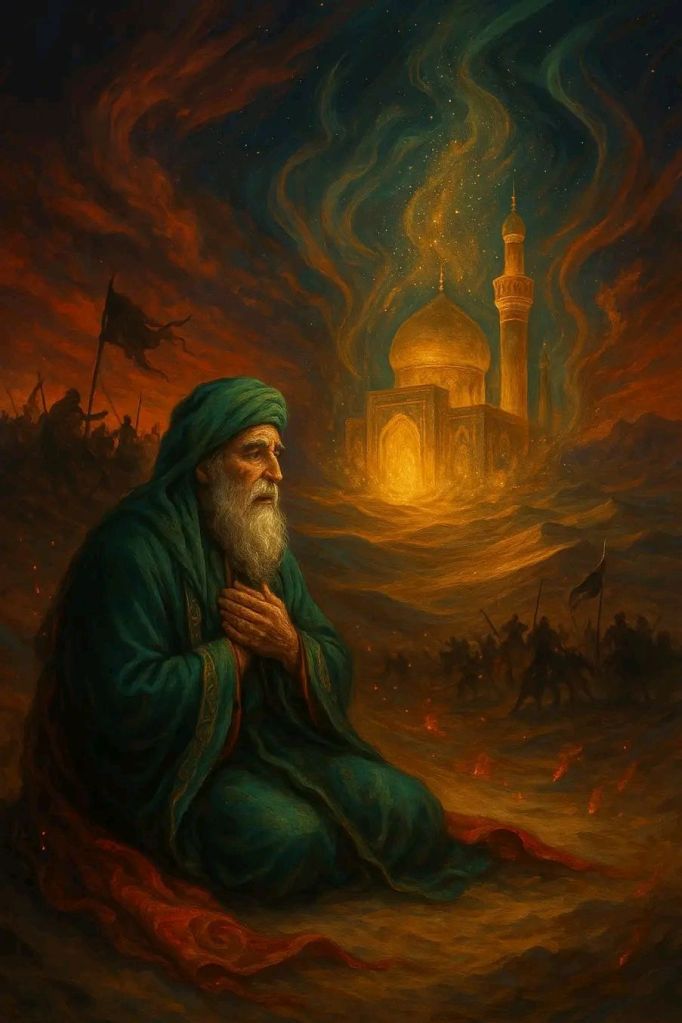
When Imam Hussain (عليه السلام), the beloved of Fatimah (رضي الله عنها), the fragrance of the Prophet ﷺ, stood on the scorching plains of Karbala, he was not standing alone. He carried the grief of his grandfather ﷺ, the message of the Qur’an, the blood of truth itself. And what did Yazid’s army do?
They thirsted them.
They surrounded them.
They slaughtered them.
Like animals? No, worse. Because animals at least recognize the sacred.
They didn’t just kill Imam Hussain (عليه السلام).
They tried to silence Noor (light).
But Noor does not die—it rises from blood like fire and flows like tears in every heart that loves the Prophet ﷺ.
How can a soul that loves the Prophet ﷺ not weep over Karbala?
And Yazid? In just four cursed years, he turned the Ummah upside down. That monster didn’t just kill the grandson of the Prophet ﷺ… He—
– In the first year, martyred Imam Hussain (عليه السلام) and his family, drenching Karbala with sacred blood.
– In the second year, he attacked Madinah, the city of peace, the city where the Prophet ﷺ rests. Yes, that blessed city was dishonored—its sanctity violated.
– In the third year, he dared to attack the Kaaba, the House of Allah ﷻ, and even burned parts of it down.
Can you imagine the weight of this on the heart of the Prophet ﷺ?
Even the birds of the sky cried.
Even the earth trembled.
Even the angels wept.
The righteous scholars wept too. Sayyiduna Sa‘eed bin Al-Musayyib (رضي الله عنه), a noble Tabi’i, said,
❝Yazid’s rule was a curse upon this Ummah.❞
Why? Because never before had such disrespect, such humiliation, such evil been unleashed with such power, in the name of “leadership”. The youth of that time were not men of wisdom, they were drunk on power. The wise and experienced were pushed aside. Evil and shamelessness spread like wildfire.
But, O seeker of truth, the more they tried to bury the light of Ahl al-Bayt, the brighter it shone. Because love—real love—cannot be erased by swords or poisoned by time.
So cry for Karbala, not just with tears from your eyes, but with your soul.
Let your tears flow for the pain of the Prophet ﷺ.
For his beloved Hussain (عليه السلام), who cried out on the burning sands, not for water, but for justice.
For the daughters of Zahra (رضي الله عنها) who were veiled in modesty but dragged through the streets of Sham.
And remember… Karbala is not a tale to read. It is a fire to carry in your heart. It is a reminder that truth never dies, even if you slaughter every soul that carries it.
Karbala is the cry of love.
Karbala is the wound of the Prophet ﷺ.
Karbala is your test—will you cry, or will you forget?
اَللّٰهُمَّ صَلِّ عَلَىٰ مُحَمَّدٍ وَّعَلَىٰ اٰلِ مُحَمَّدٍ

 Aal-e-Qutub Aal-e-Syed Abdullah Shah Ghazi