


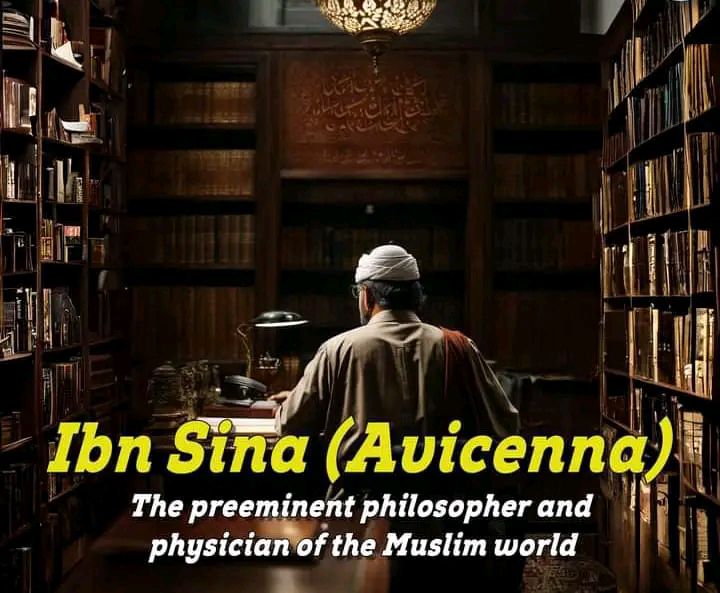
Ibn Sina is often known by his Latin name of Avicenna, although most references to him today have reverted to using the correct version of ibn Sina.
The course of ibn Sina’s life was dominated by the period of great political instability through which he lived. The Samanid dynasty, the first native dynasty to arise in Iran after the Muslim Arab conquest, controlled Transoxania and Khorasan from about 900. Bukhara was their capital and it, together with Samarkand, were the cultural centres of the empire. However, from the middle of the 10th century, the power of the Samanid’s began to weaken. By the time ibn Sina was born, Nuh ibn Mansur was the Sultan in Bukhara but he was struggling to retain control of the empire.
Ibn Sina’s father was the governor of a village in one of Nuh ibn Mansur’s estates. He was educated by his father, whose home was a meeting place for men of learning in the area. Certainly ibn Sina was a remarkable child, with a memory and an ability to learn which amazed the scholars who met in his father’s home. By the age of ten he had memorised the Qur’an and most of the Arabic poetry which he had read. When ibn Sina reached the age of thirteen he began to study medicine and he had mastered that subject by the age of sixteen when he began to treat patients. He also studied logic and metaphysics, receiving instruction from some of the best teachers of his day, but in all areas he continued his studies on his own.
The death of his father changed ibn Sina’s life completely. Without the support of a patron or his father, he began a life of wandering round different towns of Khorasan, acting as a physician and administrator by day while every evening he gathered students around him for philosophical and scientific discussion. He served as a jurist in Gurganj, was in Khwarazm, then was a teacher in Gurgan and next an administrator in Rayy. Perhaps most remarkable is the fact that he continued to produce top quality scholarship despite his chaotic lifestyle.
After this period of wandering, ibn Sina went to Hamadan in west-central Iran. Here he settled for a while becoming a court physician. The ruling Buyid prince, Shams ad-Dawlah, twice appointed him vizier. Politics was not easy at that time and ibn Sina was forced into hiding for a while by his political opponents and he also spent some time as a political prisoner in prison.
Ibn Sina’s two most important works are The Book of Healing and The Canon of Medicine. The first is a scientific encyclopaedia covering logic, natural sciences, psychology, geometry, astronomy, arithmetic and music. The second is the most famous single book in the history of medicine. These works began while he was in Hamadan.
After being imprisoned, ibn Sina decided to leave Hamadan in 1022 on the death of the Buyid prince whom he was serving, and he travelled to Isfahan. Here he entered the court of the local prince and spent the last years of his life in comparative peace. At Isfahan he completed his major works begun at Hamadan and also wrote many other works on philosophy, medicine and the Arabic language.
Ibn Sina’s wrote about 450 works, of which around 240 have survived. Of the surviving works, 150 are on philosophy while 40 are devoted to medicine, the two fields in which he contributed most. He also wrote on psychology, geology, mathematics, astronomy, and logic. His most important work as far as mathematics is concerned, however, is his immense encyclopaedic work, the Kitab al-Shifa’. One of the four parts of this work is devoted to mathematics and ibn Sina includes astronomy and music as branches of mathematics within the encyclopaedia. In fact he divided mathematics into four branches, geometry, astronomy, arithmetic, and music, and he then subdivided each of these topics. Geometry he subdivided into geodesy, statics, kinematics, hydrostatics, and optics; astronomy he subdivided into astronomical and geographical tables, and the calendar; arithmetic he subdivided into algebra, and Indian addition and subtraction; music he subdivided into musical instruments. Ibn Sina is also known to have corresponded with al-Biruni. In [10], eighteen letters which ibn Sina sent to al-Biruni in answer to questions that he had posed are given. These letters cover topics such as philosophy, astronomy and physics.
During military campaigns ibn Sina was expected to accompany his patron and many of his works were composed on such campaigns. It was on one such military campaign that he took ill and, despite attempting to apply his medical skills to himself, died in the year 1037 AD at the age of 57, and was buried in Hamadan.

 Aal-e-Qutub Aal-e-Syed Abdullah Shah Ghazi