

Ali’s participation in all the “Ghazawats
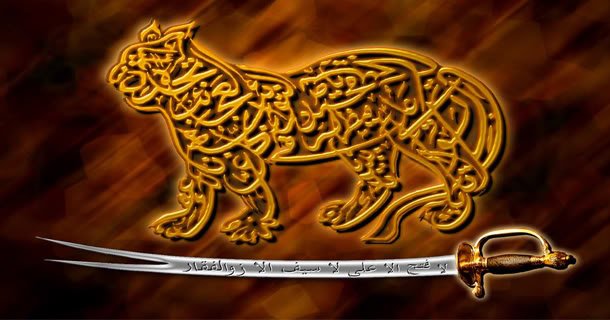
Ali AlaihisSalam is said to have participated in all the “Ghazawats” (the holy wars fought by the Holy Prophet), except the Tabuk Expedition, when he was left as Governor of Medina to look after domestic affairs. His dauntless courage, fortitude and unflinching loyalty made him the main hero of all these campaigns and the carnage of his sword “Dhulfakar” established such awe and terror in the ranks of the enemy that it led to the saying “None of the weapons slaughtered more than the ‘Dhulfakar’. It was the valour of Ali and the strength of his arms that turned the tables at critical juncture on the battlefield, and it was the victories won by him over the Meccans that ensured the triumph of Islam over polytheism.
The Battle of Uhud
In January 625 A.D. Abu Sufyan, the leader of the Meccans mustered an army of 3000 strong and marched on Medina to avenge the scandal of the defeat at Badr. Muhammad ﷺ (may peace be upon him) collected with great difficulty a force of 700 ill-equipped Muslims and 300 Jews. The Muslim army was no match for the Meccan army which was superior in arms, equipment and numbers and in the conference that Muhammad ﷺ (may peace be upon him) held with his companions he suggested that the best way to tackle such a formidable able force was to wait behind the walls of the city. The younger men, clated with the victory at Badr, clamoured to take the open field, a foolhardy course to which the Prophet ﷺ gave way only with the greatest reluctance. He led his forces out of the city to Mount Uhud.
Uhud was a great pile of barren rock rising out of the desert without any growth of vegetation. In the glare of the desert it burnt like an oven, desolate of shade. The Muslim warriors were ordered to take up their position on the rising ground, which could be an advantage in defence, and the archers were ordered to take up positions on an adjoining mound behind the main position. They were given special instructions not to leave their places for any reason whatever, with- out definite orders from Muhammad ﷺ himself.
The Meccan pagans, assisted by their womenfolk took up their stand on the plain below the hill, and so the two armies faced each other. Before the battle began the three hundred Jews, who had made common cause with the Muslims, deserted Muhammad, ﷺ which greatly elated the Meccans who had already been superior in numbers. Further, encouraged by the songs of their women, they now challenged the Muslim champions to single combats. Talha, the hereditary standard bearer of the Qurishites came out and threw down the first challenge which was accepted by Ali who stepped out from the Muslim force and crossed swords with him. Thus without any preliminary the duel began, and as Ali’s sword flashed in the sun, the head of Talha jumped from his shoulders and fell on the sand. underneath. At this Talha’s brother and other near relatives came out to fight duels, and each time Ali’s sword succeeded in chopping off their heads. When the general battle followed Ali’s sword “Dhulfakar”. wrought such a tremendous havoc in the enemy ranks. that the pagans began to take to their heels. Ali and Humza had broken through the enemy line and a Muslim victory seemed certain. The Muslim forces drove a wedge through the Meccan ranks but the Mus-lim archers posted on the adjoining mound rashly left their places to join them in the pursuit of plunder, leav- ing a critical gap in Nabi Pakﷺ defences and the Meccan general Khalid bin Walid, who had been wait- ing for just such an opportunity, wheeled his squadron round to occupy the place vacated by the Muslim archers. This changed the entire picture of the battle, the next phase of which went completely against the Muslims. The Holy Prophet’s uncle Humza was martyred as was the Muslim standard bearer Musab bin Omeir, who so much resembled the Holy Prophet in appearance. These tragic events turned the tables completely and now the Muslims began to flee before Khalid’s lancers.
Ali’s Heroism in the Battle
At this point, when defeat for the Muslims looked like turning into a rout, when their Standard-Bearer was dead and there seemed no hope of rallying them, Ali AlaihisSalam hurled himself into the Fray, there encountering Sa’d bin Abi Talha, the standard bearer of the Meccans. One stroke of Ali’s sword and Abu Sa’d fell on the ground, naked and defenceless. Pitying his sad plight, Ali left him unkilled, moving on to attack still more of the enemy with unflinching zeal. legends tell us that he killed several hundreds of them on that single his day, and that the more he fought, the greater strength became. When in one of these struggles Ali’s sword was broken Muhammad (may peace be upon gave him his own sword, which Ali kept all his life. heroism caused the angels to sing in heaven “La Fata Illa Ali La Saif Illa”Dhufakar” (there is no better youth than Ali and no better sword than Dhulfakar).

 Aal-e-Qutub Aal-e-Syed Abdullah Shah Ghazi