

EARLY LIFE
A versatile genius
“The Bayard of Islam, the hero without fear and reproach,” the first cousin of the holy Prophet Muhammad ﷺ (may peace be upon him) and adopted by him as his own son, whose daughter Fatima AlaihisSalam he subsequently married, the second or third convert to Islam, the staunchest supporter and most valiant warrior that ever championed the cause of Islam-such was Ali AlaihisSalam . Ali, the alter ego of Muhammad ﷺ (may peace. be upon him) is a colossal figure in the annals of Islam and one who has made for himself an honoured place in the history of all mankind, not only as the fourth and last of the “strict and stern” orthodox Caliphs, the legitimate successors of the holy Prophet, but also as a genius among men.
Ali AlaihisSalam was a man of many and varied talents, one of the greatest savants, legislators, generals, statesmen, scholars and administrators the world has ever known. In his person he combined the knowledge of Adam, the virtues. of Noah, the devotion of Abraham, the awe and majesty of Moses, the abstinence and piety of Jesus Christ, the patience and resignation of Job, the wisdom of Solomon, the prowess of Alexander, the iron determination of Julius Caesar, the sagacity and prudence of Plato, the
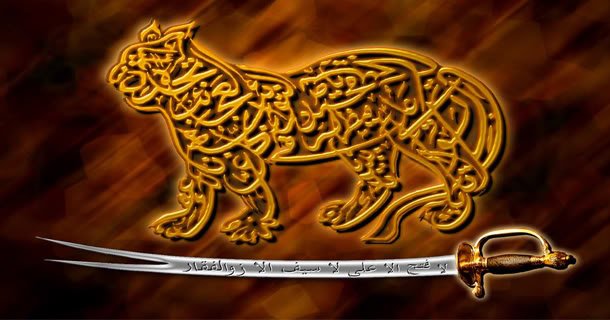
(Major Osborn bestows these appellative titles on Hazrat Ali AlaihisSalam)scholastic accomplishments of Cicero and the reformative zeal of Justinian. Ever since his death countless gene- rations of Muslims have felt themselves uplifted in pay- ing homage to him, the most versatile genius of all time. In the annals of Islam Ali’s name is synonymous with a redoubtable military prowess that became legendary. His invincible scimitar “Dhulfakar” which he wielded. with both hands, was famous throughout the land, and his Herculean exploits have led to his being depicted as a hero comparable in achievement to Homer’s heroes of Ancient Greece. In Muslim countries today the believers in faith continually refer with pride to the numberless exploits of this “beau ideal”, this brightest star of the Islamic firmament. Tales aslo abound in Muslim literature of the prodigious achievements of Ali AlaihisSalam in piety, of his acute sense of justice, his generosity, his selfless existence, his concern for the uplift of humanity, and his unceasing endeavours to establish God’s kingdom on this earth, while the preservation of his brilliant sayings pays tribute to the genius of his mind. The combination of such qualities of head and heart, together with such prowess in arms has lent to his deeds an appearance of the miraculous. In Muslim theology Ali AlaihisSalam is one of the blessed ten (“Ashrah Mu- basharah”) to whom paradise has been foretold, through Muhammad ﷺ (may peace be upon him) by God.
Other titles indicate the admiring reverence with which Muslims think of him. He is “Al-Murtaza” (the chosen one of God), “Abu Hasan” (father of good- ness), and the great “Amir-ul-Momineen” (Commander of the Faithful). His military exploits are reflected in the sobriquet “Haidar” literary “Lion”.
His birth
He was the son of Hazrat Abu Talib, an uncle of the holy Prophet Muhammad ﷺ (may peace be upon him). Thus he belonged to the Hashimite family of the Quraish tribe, and was the first cousin of the Apostle of God.
Early Life
Abu Talib’s wife Fatima was the daughter of Asad, the famous magnate of the Quraish clan. Fatima gave birth to Ali AlaihisSalam, in the sanctuary of Ka’bah (House of God) at Mecca on the 13th or 16th day of the month of Rajab in the 28th year of “Am Ul-Fil” (the year of Elephants) an era which was established to comme- morate the Arab victory over the Christian general, Abrah, who had been deputed by Negus, the ruler of Abyssinia, to invade Mecca with horses and elephants. Thus Ali was some thirty years younger than the Holy Prophet Muhammad ﷺ, who was born in the first month of Rabi in the year of the Elephants: the year 886 from the accession of Alexander the Great of Macedon and 570 of the Christian era
Tradition places the birth of Ali AlaihisSalam in the peaceful and holy month of Rajab (the seventh month of the Muslim calendar) when God showers His countless blessings on mankind. “The thirteenth of Rajab” says a muslim writer, “marks the birth of a most precious pearl in the courtyard of the Ka’bah, glowing in its full self-illumination. It was a portion of the very divine light of God that appeared in the human shape and form, and commenced to shine on the highest of the human stages of dignity and reverence.” It was in the month of Rajab that Arabs from the length and breadth of their country used to come to Mecca for pilgrimage. Ali’s mother, Fatima, an embodiment of chastity and piety, was amongst those pilgrims and with them was viewing the Ka’bah, when she suddenly felt the pains of child birth and prayed to God to help her delivery. A miraculous opening is said to have appeared in the wall of the Ka’bah and to have closed again after Fatima had lodged herself in the cavity. After three days the wall is said to have opened once more whereupon Fatima emerged, radiant and with the babe in her arms. The traditions allege that Ali had already ac- cepted Islam in his mother’s womb and that even during the period of her pregnancy he had always hindered her if she sought to prostrate herself before an idol.
The superstitions Arabs of those times, held that every person as he came into the world was touched by the devil, which was why new-born babies cry at birth. Since Ali AlaihisSalam was born in a sanctuary to which the devil had no access; he did not cry at birth but was found smiling and without consciousness of original sin. Thus God had interposed a veil between the evil spirits and the child who was to grow up to exalt His Holy Name. Ali AlaihisSalam has therefore been variously described as having been found like a pearl in the Shell of Ka’bah, or as a sword in the sheath of Allah’s house, or as a lamp found in Allah’s abode shedding light around.

 Aal-e-Qutub Aal-e-Syed Abdullah Shah Ghazi