
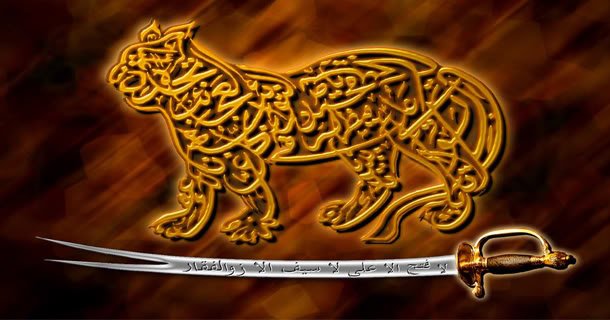


273. “Muhammad ﷺ is the Messenger of Allah; and those with him are forceful against the disbelievers, merciful among themselves…”
“Muhammad ﷺ is the Messenger of Allah; and those with him are forceful against the disbelievers, merciful among themselves. You see them bowing and prostrating [in prayer], seeking bounty from Allah and [His] pleasure. Their mark is on their faces from the trace of prostration. That is their description in the Torah. And their description in the Gospel is as a plant which produces its offshoots and strengthens them so they grow firm and stand upon their stalks, delighting the sowers – so that Allah may enrage by them the disbelievers. Allah has promised those who believe and do righteous deeds among them forgiveness and a great reward.” [Qur’an 48:29]
274. Chosroes suffered great ruin and destruction through disrespecting the Messenger of Allah ﷺ
● Chosroes, ruler of Persia, tore up the letter sent to him by the Messenger of Allah. When the Messenger of Allah received news of this, he prayed: “O Allah, slit him as he slit my letter!” It was as a result of this malediction that Chosroes’ son cut him to pieces with a dagger. [Bukhari; Qadi Iyaad, al-Shifa] And it is further reported that later in history, Sayyidina Saa’d b. Abi Waqqas broke his kingdom apart, so that in no part of the Sasanid empire did his sovereignty remain. [Sirat ibn Hisham; Imam Tabari, Tarikhu’lUmma wa’l-Muluk; Hafiz ibn Kathir’s al Bidaya wal-Nihaya]
275. The Messenger of Allah ﷺ will accept the responsibility of intercession on the Day when everyone else will turn us away.
● “It may be that your Lord will raise you to maqaam Mahmud (an Exalted Station).” [Qur’an 17:79] On this verse, Hafiz ibn Kathir states in his tafsir: “I, Ibn Kathir, say: He is the first one for whom the earth will be opened and he will come forth riding to the gathering place. He will have a banner under which Adam and anyone else will gather, and he will have the Hawdh (Lake) to which no one else will have more access than he. He will have the right of the Grand Intercession with Allah when He comes to judge between His creation. This will be after the people ask Adam, then Nuh, then Ibrahim, then Musa, then ‘Isa to intercede, and each of them will say, “I am not able for that.” Then they will come to Muhammad, ﷺ peace and blessings of Allah be upon him, and he will say, “I can do that, I can do that.” [Tafsir ibn Kathir]
276. The light of the Messenger of Allah ﷺ was placed in the forehead of Prophet Adam. • Imam Muhyuddin ibn Arabi states: “When Allah created our father Adam, He placed the light of Muhammad, His first creation, on Adam’s forehead. When the angels encountered Adam, they paid respect and greeted that light, but Adam was dismayed, being unable to see the divine light of Muhammad shining on his own forehead…” [Imam ibn Arabi’s Shajarat al-Kawn]
277. The full reality of the Messenger of Allah is unknown to us and beyond our limited comprehension.● “If the strength and valour of forty warriors were put into one man, who could drag a lion by the ear, and if that man saw the truth of the Prophet for a single moment, the awe he’d feel would tear his lungs from his chest & his soul would leave him.”~ Shaykh Ahmad Dabbagh
278. The blessed lineage of the Messenger of Allah consists of exactly fifty males and fifty females.
• Imam Yusuf Nabhani relates, “The father and the mother of Prophet Muhammad were the final links of light, which had passed from a hundred people: fifty of whom were male, and the other fifty female.” [Imam Yusuf Nabhani’s Hujjatallahi alal-Alameen]
279. “He was solely of love. Thus, God selected him from among the Prophets…” • Mawlana Jalal uddin Rumi evaluates the creation of the Messenger of Allah with love: “Love boils the sea like clay. Love smashes and melts the mountains like sand. Love ruptures the sky, opening hundreds of cracks. Love shakes the earth with no reason. The immaculate love was equivalent to Prophet Muhammad. Because of love, God said to him, “If you had not existed, (I would not have created the worlds)…”
He was solely of love. Thus, God selected him from among the Prophets;
“If you had not been of immaculate love, if you had not possessed love, would I have created the Heavens?” [Mathnawi, v. 223-4]
280. The blessed spirit of the Messenger of Allah is the sultan or ruler over all creation. Imam Muhyuddin ibn Arabi says, when the essence of Prophet Muhammad ﷺ existed, it existed as the ruler, sultan and the one who is guarded. When the creation of the body was delayed, Allah created agents on behalf of him. His first agent and viceroy was Adam. Then the reproduction and proliferation of humanity began; Allah had always created viceroys through all eras until the pure body of the Prophet Muhammad ﷺ was achieved. The body of Prophet Muhammad ﷺ appeared like a strong sun. Now all the lights were contained in his vivid light, all the verdicts were hidden in his verdicts, all the laws yielded to him and his hidden rule emerged. As a consequence, Prophet Muhammad is the “first, last, spiritual and the all knower.” [Futuhat al-Makkiya]
281. The Messenger of Allah responded to a Bedouin Arab’s call at his blessed grave. • Imam al-Nawawi relates on al-‘Utbi’s authority: “As I was sitting by the grave of the Messenger of Allah, a Bedouin Arab came and said: “Peace be upon you, O Messenger of Allah! I have heard Allah saying: “If they had only, when they were unjust to themselves, come unto thee and asked Allah’s forgiveness, and the Messenger had asked forgiveness for them, they would have found Allah indeed Oft-Returning, Most Merciful.” [Qur’an 4:64]. Therefore, I have come to you asking forgiveness for my sin, seeking your intercession with my Lord.” Then he began to recite poetry: “O best of those whose bones are buried in the deep earth, And from whose fragrance the depth and the height have become sweet, May I be the ransom for a grave which thou inhabit, And in which are found purity, bounty and munificence!” Then he left, and I dozed and saw the Messenger of Allah in my sleep. He said to me: “O ‘Utbi, run after the Bedouin and give him glad tidings that Allah has forgiven him.” [Imam al-Nawawi, al-Idah fi Manasik al-Hajj & al-Adhkaar]

 Aal-e-Qutub Aal-e-Syed Abdullah Shah Ghazi